


How does a general-purpose rubber-sheathed flexible cable reduce the risk of breakage under high-speed rotation through its anti-torsion structure?
Release Time : 2026-03-17
In modern industry and daily life, the efficient operation of power tools, household appliances, and various mobile electrical devices relies on the silent "blood vessels" that transmit energy—flexible cables. However, under conditions of high-speed rotation, frequent bending, or complex movement, ordinary cables often break due to internal stress concentration, leading to equipment downtime or even safety accidents. General-purpose rubber-sheathed flexible cables, through innovative anti-torsion structure design and the application of high-performance materials, successfully mitigate the risk of breakage under high-speed rotation, becoming a crucial link between power and safety.
1. Failure Mechanism under High-Speed Rotation: The Fatal Threat of Torsional Stress
To understand the importance of the anti-torsion structure, it is first necessary to analyze the stress characteristics of the cable under rotation. When the cable rotates at high speed with the equipment, without an effective anti-torsion design, the conductor core will twist spirally like a tightly wrung towel. This torsional force generates enormous shear stress inside the conductor, leading to fatigue fracture of the copper wires. More seriously, traditional parallel stranded structures are prone to the "birdcage effect" during rotation, where the outer conductors bulge outwards, puncturing the insulation layer and causing a short circuit. Furthermore, repeated twisting can cause the insulation material to separate from the conductor, creating gaps and accelerating aging. Therefore, simply increasing material thickness cannot solve the fundamental problem; innovation at the structural mechanics level is necessary.
2. Core Breakthrough: Layered Reverse Stranding and Central Tension Balance
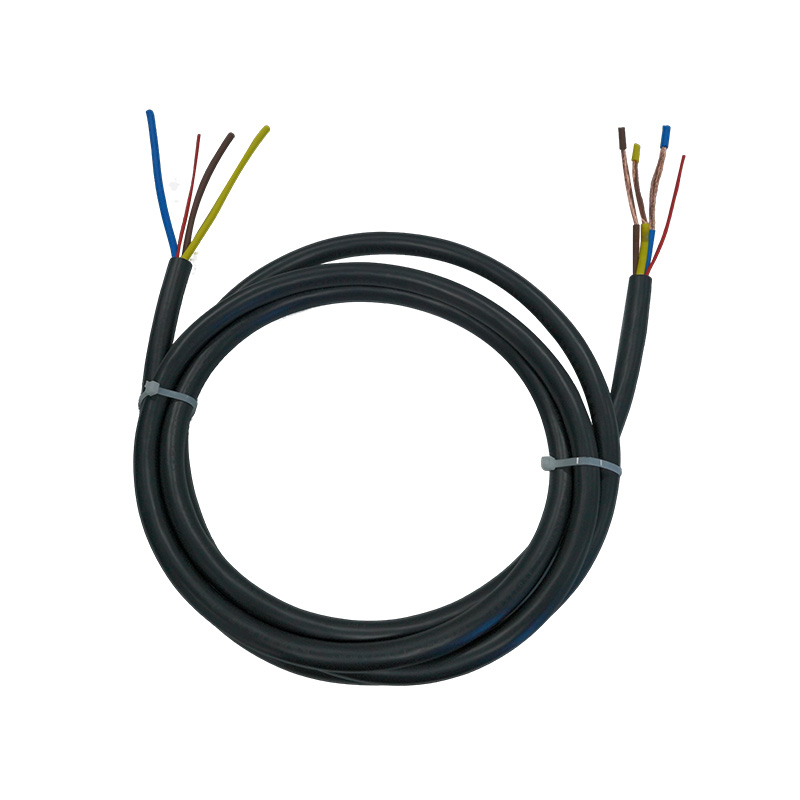
The secret to the torsion resistance of general-purpose rubber-sheathed flexible cable lies in its precise layered reverse stranding structure. During manufacturing, engineers first strand multiple fine copper wires into strands, then strand these wires together into a cable core with a specific pitch and direction. Crucially, the stranding directions of adjacent layers are opposite. This design utilizes the principle of self-balancing in mechanics: when the cable is subjected to external torsional torque, the reaction forces generated by different layers of conductors cancel each other out, thus greatly reducing the net torsion angle of the overall structure.
3. Material Enhancement: Flexibility and Protection of EPDM Insulation
Besides structural innovation, the choice of materials is also a decisive factor in torsion resistance. These products widely use EPDM rubber as both insulation and sheathing material. Compared to traditional PVC, EPDM boasts superior molecular chain flexibility, rapidly recovering its original shape after extreme bending and torsional deformation, exhibiting an extremely low permanent deformation rate. This high elasticity means that under dynamic stress generated by high-speed rotation, the insulation layer will not crack due to stiffness, but rather buffers energy like a spring.
4. Application Scenarios and Safety Value
Thanks to its superior torsional structure and material properties, this general-purpose rubber sheathed flexible cable has been widely used in various harsh environments. In handheld power tools, it can withstand the careless swinging during operation and the high-speed vibration of the motor; in household appliances, it ensures the long-term reliability of moving parts connections; in outdoor machinery, it is unaffected by wind, rain, and oil contamination. Every safe rotation and every moment of stable power delivery is the best validation of its torsional design.
In summary, the general-purpose rubber sheathed flexible cable constructs a complete torsional protection system through the mechanical balance of layered reverse twisting, load distribution by the central tension element, and the high elasticity and weather resistance of EPDM material. It not only solves the problem of fracture under high-speed rotation, but also provides a solid safety guarantee for the flexible movement of modern electrical equipment, allowing power transmission to remain unhurried in dynamic situations.
1. Failure Mechanism under High-Speed Rotation: The Fatal Threat of Torsional Stress
To understand the importance of the anti-torsion structure, it is first necessary to analyze the stress characteristics of the cable under rotation. When the cable rotates at high speed with the equipment, without an effective anti-torsion design, the conductor core will twist spirally like a tightly wrung towel. This torsional force generates enormous shear stress inside the conductor, leading to fatigue fracture of the copper wires. More seriously, traditional parallel stranded structures are prone to the "birdcage effect" during rotation, where the outer conductors bulge outwards, puncturing the insulation layer and causing a short circuit. Furthermore, repeated twisting can cause the insulation material to separate from the conductor, creating gaps and accelerating aging. Therefore, simply increasing material thickness cannot solve the fundamental problem; innovation at the structural mechanics level is necessary.
2. Core Breakthrough: Layered Reverse Stranding and Central Tension Balance
The secret to the torsion resistance of general-purpose rubber-sheathed flexible cable lies in its precise layered reverse stranding structure. During manufacturing, engineers first strand multiple fine copper wires into strands, then strand these wires together into a cable core with a specific pitch and direction. Crucially, the stranding directions of adjacent layers are opposite. This design utilizes the principle of self-balancing in mechanics: when the cable is subjected to external torsional torque, the reaction forces generated by different layers of conductors cancel each other out, thus greatly reducing the net torsion angle of the overall structure.
3. Material Enhancement: Flexibility and Protection of EPDM Insulation
Besides structural innovation, the choice of materials is also a decisive factor in torsion resistance. These products widely use EPDM rubber as both insulation and sheathing material. Compared to traditional PVC, EPDM boasts superior molecular chain flexibility, rapidly recovering its original shape after extreme bending and torsional deformation, exhibiting an extremely low permanent deformation rate. This high elasticity means that under dynamic stress generated by high-speed rotation, the insulation layer will not crack due to stiffness, but rather buffers energy like a spring.
4. Application Scenarios and Safety Value
Thanks to its superior torsional structure and material properties, this general-purpose rubber sheathed flexible cable has been widely used in various harsh environments. In handheld power tools, it can withstand the careless swinging during operation and the high-speed vibration of the motor; in household appliances, it ensures the long-term reliability of moving parts connections; in outdoor machinery, it is unaffected by wind, rain, and oil contamination. Every safe rotation and every moment of stable power delivery is the best validation of its torsional design.
In summary, the general-purpose rubber sheathed flexible cable constructs a complete torsional protection system through the mechanical balance of layered reverse twisting, load distribution by the central tension element, and the high elasticity and weather resistance of EPDM material. It not only solves the problem of fracture under high-speed rotation, but also provides a solid safety guarantee for the flexible movement of modern electrical equipment, allowing power transmission to remain unhurried in dynamic situations.